
Why dogs react on lead
Reactivity is often rooted in fear, frustration, over-arousal, lack of space, or feeling trapped. It is not your dog being difficult on purpose, and it is not solved by punishing the barking.
If your dog barks, lunges, freezes, or seems fine off lead but falls apart once the lead goes on, this page is for you.
One of the things I hear most from owners with reactive dogs is that walks stop feeling like walks. They become scanning, crossing the road, apologising, bracing, and hoping the next dog, person, bike, or trigger does not appear too close. That is exhausting for you and for your dog.
The goal is not to force your dog through it or make the reaction disappear by pressure. It is to understand what they are telling you, spot the earlier signs, and build safer, calmer patterns at a pace they can actually cope with.
Jennie works across Essex, including South Woodham Ferrers, Chelmsford dog training and behaviour support, Maldon, Braintree dog training and behaviour support, and nearby areas, helping owners who searched for reactive dog training near me and need one-to-one support that fits real walks, real triggers, and real dogs.
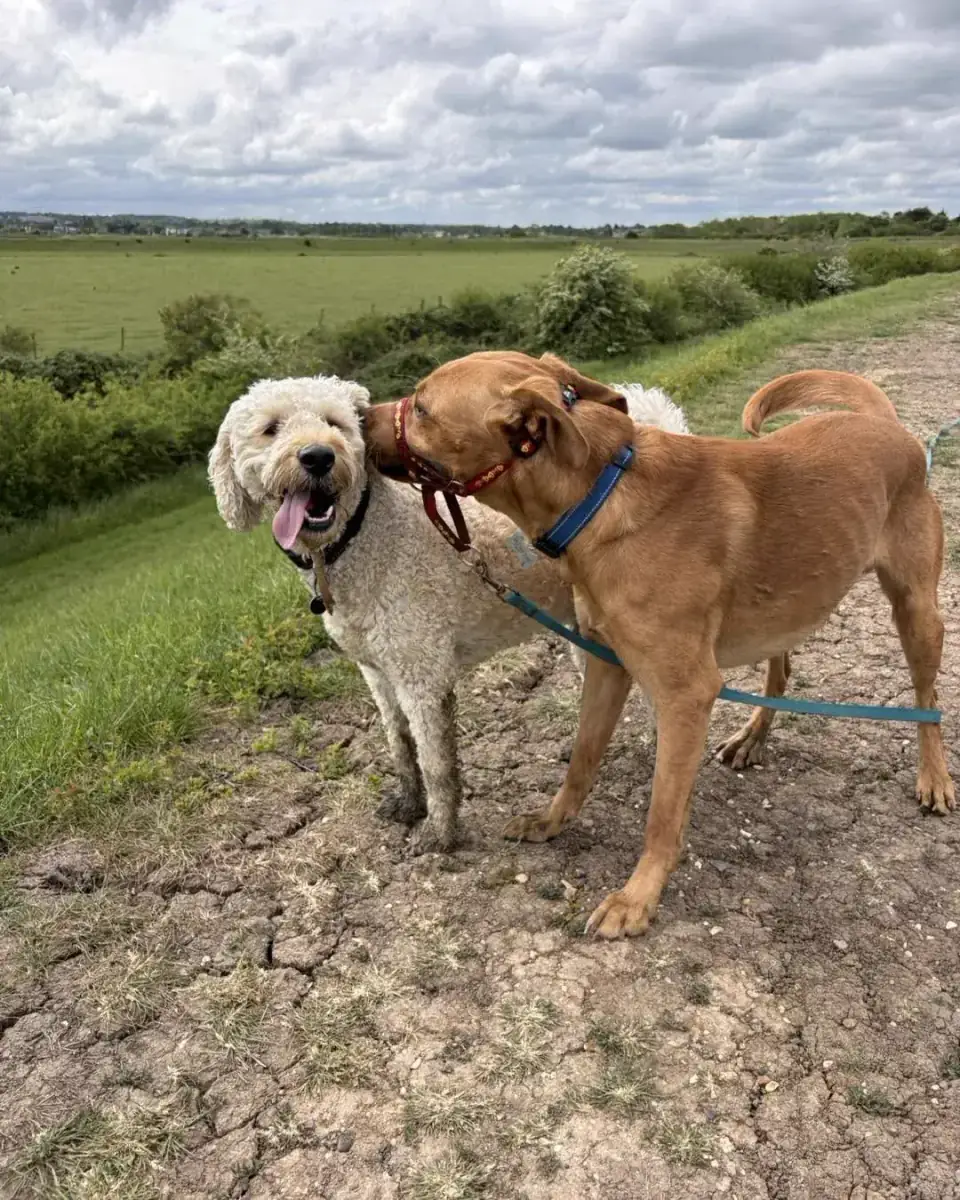
Real-life reactive dog on lead help
Quieter routes, better spacing, calmer movement, and clearer timing help both ends of the lead make better decisions before the whole walk blows up.
6+ years experience 27 five-star Google reviews DBS checked & canine first aid trained
Most owners are not just looking for a dog that stops barking. They want to understand why the reaction happens on lead, how to stop rehearsing the same stressful pattern, and how to make everyday walks feel less exhausting.
Jennie's approach looks at the whole picture: trigger distance, handler movement, route choice, recovery time, reward timing, and whether the dog is coping or already overwhelmed.
This comes from six years of hands-on behaviour work with reactive dogs in real homes and on real walks, learned alongside an experienced behaviourist as well as through formal study.
Reactivity is often rooted in fear, frustration, over-arousal, lack of space, or feeling trapped. It is not your dog being difficult on purpose, and it is not solved by punishing the barking.
Some dogs cope better off lead because they have more freedom to move, create space, and use their body naturally. The lead can add tension, frustration, and a feeling of being trapped, which is why some dogs are only reactive once the lead goes on.
Many owners feel embarrassed, judged, or like they have somehow caused the problem. Part of the work is helping you feel calmer and clearer too, so you are not going into every walk already tense.
Recent UK dog behaviour statistics show that lead walking, reactivity, barking, and owner overwhelm are common enough to deserve calm, practical support rather than blame.
Progress usually starts with better setups, fewer overwhelming moments, and more successful decisions from both you and your dog before it turns into truly calmer walks.
Support may begin with a behaviour consultation at home, then move into assisted lead walks if the biggest challenge is outside. That gives you a proper plan as well as real-time coaching in the situations that are actually hard.
For owners in South Woodham Ferrers, Chelmsford, Maldon, and nearby Essex areas, that often means building confidence in easier setups first before moving into busier routes.
Reactive Walk Focus is how Jennie structures reactive dog on lead support so it moves in a clear order, rather than jumping straight to "just walk them more."
A behaviour consultation at home to understand your dog's history, triggers, routines, and how the reactivity shows up beyond the walk itself.
Working out what your dog reacts to, at what distance, and how early the warning signs appear, so you are not guessing on every walk.
Practising calmer setups at a distance your dog can cope with, reading their body language, and adjusting before they go over threshold.
Real-time coaching out on actual walks once the groundwork is in place, so the plan is tested and adjusted where the hard moments really happen.
Clear notes after sessions so you know what to practise, what to watch for, and what progress should look like before the next check-in.
Jennie's support is positive reinforcement based, one-to-one, and focused on practical changes to routes, distance, timing, and handling. This is not a clinical or veterinary service.
If your dog's reactivity is sudden, severe, linked to pain, or if you are worried about a bite risk that feels beyond what walk management can address, it is worth speaking to your vet first, or asking about a referral to a clinical animal behaviourist alongside this support. Jennie can still help with the day-to-day walk and handling side either way.
Lead reactivity usually needs a behaviour plan and, for many dogs, assisted lead work where the hard moments actually happen. Tell Jennie what your dog reacts to, where it happens, and how walks feel at the moment.
Your dog notices the trigger, but comes back down faster rather than staying wound up for the rest of the walk.
You feel clearer about when to move away, when to reward, and how to stop tense handling feeding the whole moment.
Not every walk has to be perfect for progress to be real. Fewer overwhelming moments and more manageable setups matter a lot.
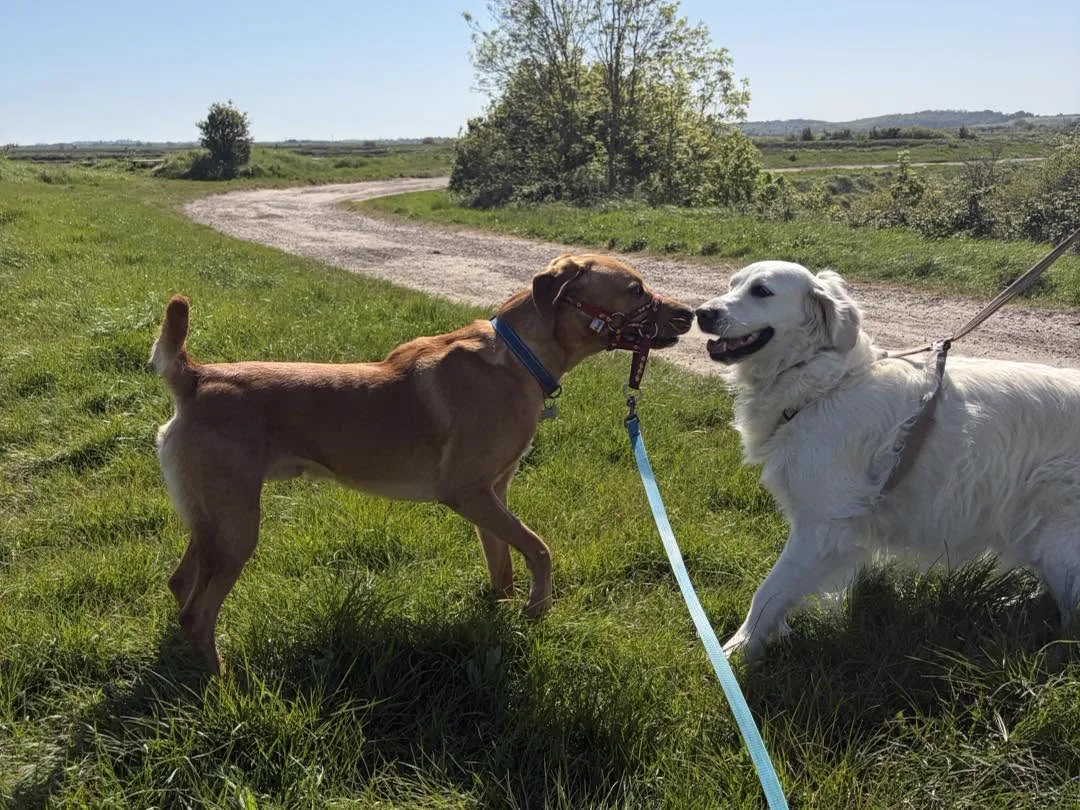
When your dog can pass or briefly greet another dog without tipping over threshold, that is real, measurable progress.
“Otis is a rescue, and things haven’t always been easy for him or for us. Since working with Jennie, the improvement we have seen in him has been incredible.”
rescue dog, reactivity and confidence
We honestly can’t thank Jennie enough for everything she has done for us. She has been absolutely amazing from the very beginning and has helped us so much with her guidance, support and expertise. Otis is a rescue, and things haven’t always been easy for him or for us. He has had his challenges, particularly with his reactivity and confidence, and at times it has felt overwhelming trying to know how best to help him. Since working with Jennie, the improvement we have seen in him has been incredible. We understand him so much better now and, more importantly, we feel much more confident in knowing how to support him. Jennie is incredibly knowledgeable, patient and kind, and she always took the time to explain not just what we should do, but why. Her advice has been invaluable and has given us practical things we can continue working on with Otis every day. Most of all, it is so clear how much Jennie genuinely cares about the dogs she works with. She took the time to understand Otis as an individual rather than simply focusing on his behaviours, and that made such a difference to us. We have seen such a positive change in Otis since our sessions with Jennie, and we are so grateful for all the support and reassurance she has given us along the way. We really couldn’t recommend her highly enough!
“Jennie’s training has transformed how I look at the obstacles ahead between me and my pup.”
reactive rescue pup and trust building
Jennie has opened my mind to so many tools to help my rescue pup. I came to her with mainly reactive behaviour around other dogs and selective listening. She demonstrated how to get my newly rescued reactive pup to look at me and actually listen, then solidified the training on our second meet up. Her training has transformed how I look at the obstacles ahead between me and my pup, and I now feel much clearer about what to do.
“Life on our walks has drastically improved.”
understanding reactivity on walks
If you’re hesitant, I would 100% recommend Jennie. After the first home lesson with Jennie we noted a vast improvement in our behaviour, so the dog has followed suit. Jennie has already helped us understand what makes our dog react and life on our walks has drastically improved.
“I actually enjoy spending time with him now instead of dreading what he’ll be like.”
reactive Rottweiler support
I approached Jennie due to having a reactive Rottweiler. Spending time with Jennie has taught me more about my dog’s behaviours and why he reacts the way he does, and it has given me the confidence to take things in my stride instead of feeling overwhelmed.
“Walking properly on a lead started to improve.”
rescue Border Collie and lead walking
Jennie came to see us at home to help with our new rescue Border Collie. She was very thorough in her advice and clearly knew her stuff as our dog was very responsive. We went for a walk and she made various suggestions which seem to be working as regards walking properly on a lead.
It is to understand what they are telling you, spot the earlier signs, and build safer, calmer patterns at a pace they can actually cope with. Part of that work is helping you feel calmer and clearer too, so you are not going into every walk already tense.
Online guides and videos can help with mild reactions at an early stage. These are the signs that one-to-one support will move things forward faster than self-help alone.
If any of these apply, one-to-one dog behaviour training in Essex is usually the most effective route forward.
Jennie calls every new enquiry back personally to hear about your dog and confirm whether one-to-one support is the right fit before anything is booked.
Jennie's Positive Paws is based in South Woodham Ferrers and provides one-to-one dog training and behaviour support across Mid and South Essex.
Tell Jennie about your dogUse this page if lunging at dogs is the most obvious part of the reactive picture and you want the more specific explanation first.
Read the guideStart here if your dog's on-lead reactions are part of a wider behaviour picture and you want a tailored behaviour plan first.
Open behaviour supportIdeal when you want real-time coaching on walks, a short prep consult first, or steadier follow-on support rather than only talking through the problem at home.
Open assisted walksUseful if pulling, pacing, and general lead chaos are a big part of what is making walks feel hard.
Read the guideExplore the Chelmsford page if you want more local, one-to-one support in that area.
See local pageUse the Braintree page if you want local support there and a calmer route forward on walks.
See local pageUse the Maldon page if you are based in or around Maldon and want local one-to-one walk and behaviour support.
See local pageUse the Southend page if you are in the SS postcode area and want local support for reactive or busy-environment struggles.
See local pageUse the Colchester page if you want local, one-to-one puppy and behaviour support, including help built around this reactivity approach.
See local pageIf you are not sure whether to start with a consultation or assisted walks, get in touch and Jennie can guide you.
Ask Jennie firstQuite often it is because the lead changes how your dog feels and moves. The lead can add tension, frustration, and a feeling of being trapped, which is why some dogs cope better off lead but struggle once they lose that freedom and space.
Yes. Support focuses on safety, distance, calmer setups, and helping your dog feel more secure rather than punishing the reaction itself. The aim is to reduce overwhelm and build better choices over time.
That is one of the most common reasons owners get in touch. The first step is usually understanding thresholds, choosing better distances, reducing lead tension, and stopping every walk from turning into a rehearsal of the same difficult pattern.
The most effective starting point is usually more space, calmer movement, and earlier timing. Try to notice the other dog before your dog is already reacting, create distance, keep the lead soft where it is safe to do so, and reward your dog for noticing calmly or turning back to you.
If your dog is already barking or lunging, they are probably over threshold and not in the best place to learn. Move away calmly, let them recover, and use that information to choose an easier distance next time.
Enough distance is the point where your dog can notice the trigger but still eat, sniff, move with you, or respond to their name. For some dogs that might be across the road. For others it might be much further away at first.
Use quieter routes, wider paths, parked cars, side streets, field edges, or simple U-turns to give your dog more room. The aim is not to avoid life forever; it is to stop every walk becoming another practice run of the same reaction.
Early signs can include staring, freezing, closing the mouth, leaning forward, a higher tail, slower movement, scanning, refusing food, sudden pulling, or a body that looks stiff rather than relaxed. Some dogs also go quiet before they explode into barking or lunging.
These early signs are useful because they give you a chance to add distance or change direction before your dog tips over threshold.
Yes, when it is done at a distance your dog can cope with. In plain English, counter-conditioning means helping your dog build a better emotional response to the thing they currently find hard, often by pairing the trigger with something good before the reaction starts.
It is not about distracting your dog from everything forever. It is about changing the setup so your dog can see the trigger, stay under threshold, and learn that calmer choices are possible.
There is no single best setup for every reactive dog. The safest option depends on your dog's size, strength, body shape, history, and what you can handle confidently. A well-fitted harness, suitable lead, and sometimes a double-ended lead can help, but equipment should never be used to cause pain, fear, or panic.
If handling feels unsafe or your dog is very strong, it is worth getting one-to-one support so the setup, route, distance, and training plan all work together.
It depends on the wider picture. If the issue is mostly outside, assisted lead walks can be a strong route. If the on-lead reactions are part of a bigger behaviour pattern, Jennie may suggest a behaviour consultation or a short prep consult first so the outdoor work starts with a clearer plan.
Yes. Jennie offers reactive dog on lead support across her Essex service area, including South Woodham Ferrers, Chelmsford, Maldon, Braintree, and nearby locations where the setup is a good fit.
Yes. Reactivity does not always look noisy. Some dogs freeze, stare, or shut down before they bark or lunge, and those signs matter just as much. Support looks at the whole stress picture, not only the biggest visible reaction.
Yes. Loose lead work can be part of it, but reactive dog on lead support goes deeper into triggers, threshold, emotional response, and what to do when the outside world feels too much. Some dogs need both, which is why Jennie links the two routes together.
Some owners need a fuller behaviour plan first. Others are ready for assisted lead walks straight away. Either way, the goal is the same: less dread, better setups, and calmer walks for both of you.
Still not sure this is the right fit for your dog? Try the quick Help Finder.